Mission Archive / Signal Log
The Face on Mars: The Full Story Behind the Red Planet's Most Famous Photograph
Few images from the history of planetary exploration have traveled as far outside the world of science as the Face on Mars. A single grainy photograph, taken almost by accident during a routine survey in 1976, spent the following decades appearing on magazine covers, documentary specials, late night radio shows, and eventually entire books built around the idea that Mars once carried a civilization capable of carving monuments into its own bedrock.
The real story turns out to be stranger in its own way than the legend, mostly because the explanation is so thoroughly ordinary, and because a single striking coincidence of light and shadow managed to outrun that explanation in the public imagination for decades.
This article traces the Face on Mars from the exact moment it was photographed through to the sharper images that eventually settled the question, and explains why so many people still search for it today, decades after planetary geologists closed the case.
The Face on Mars refers to a mesa, a raised, flat topped hill, located in a region of the northern Martian hemisphere called Cydonia. Photographed from orbit at a particular angle and under a particular quality of light, the formation's combination of ridges, shadows, and erosion patterns creates an impression that closely resembles a human head, complete with what looks like eyes, a nose, and a mouth.
The feature itself is about one and a half kilometers across, roughly a mile, and sits among dozens of similar hills and knobs scattered throughout Cydonia. What set it apart from its neighbors was never its size or its geology. It was the accident of illumination that made one particular hillside look, for a moment, like a deliberate carving instead of a hill worn down gradually by wind and time.
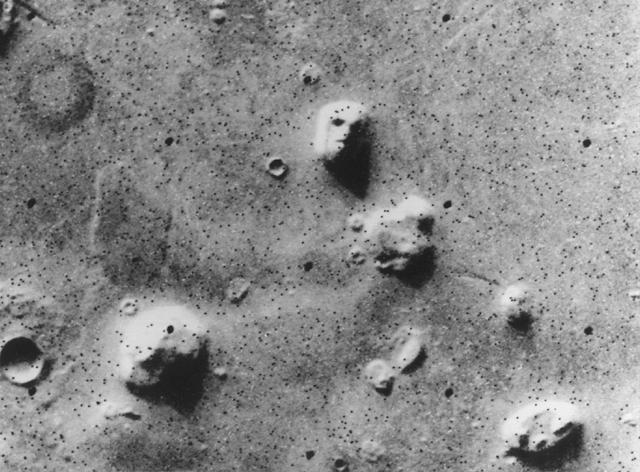 The original Viking 1 image of the Cydonia formation, taken July 25, 1976. The speckled texture across the frame comes from transmission errors, some of which fall directly across what looks like the figure's eyes. Credit: NASA/JPL.
Viking 1 arrived at Mars in the summer of 1976 as part of a two spacecraft program designed to search for signs of life and study the planet's surface in detail. The full Viking program, combining both orbiters and both landers, would eventually return more than 52,000 images and map about 97 percent of the Martian surface before the mission wound down years later. While its sister mission, Viking 2, prepared for its own landing, Viking 1's orbiter spent its time photographing candidate landing sites across the northern plains, cataloging terrain that might be safe, or unsafe, for a lander to touch down on.
On July 25, while scanning the Cydonia region for exactly this purpose, the orbiter's camera captured an image showing a cluster of hills, one of which stood out immediately to the mission scientists reviewing the data. NASA released the photograph to the public less than a week later, in a press statement that described, almost in passing, a large rock formation resembling a human head. The line was meant as a bit of human color in an otherwise technical mission update. It became the seed of everything that followed.
The image itself was far from perfect. Photographs sent back from Mars in the 1970s traveled across hundreds of millions of kilometers as compressed data streams, and the version of the Cydonia photo that reached Earth carried visible transmission errors, small blocks of missing or corrupted pixels scattered across the frame. Several of those errors happened to fall across the formation's face at points that would later be interpreted as one eye and one nostril, adding an extra, entirely unintentional layer of symmetry to an image that already resembled something it was not.
NASA's own scientists moved on quickly. Viking's mission was to survey landing sites and study the planet's geology, and a single unusual looking hill, however photogenic, was a minor curiosity next to the mission's broader science goals. The public reaction went in a very different direction.
Within a few years, independent researchers outside the space agency began building elaborate theories around the photograph. Vincent DiPietro and Gregory Molenaar, two engineers who had worked on image processing at NASA's Goddard Space Flight Center, obtained a copy of the Viking data and ran it through digital enhancement techniques of their own, arguing the resulting image showed signs of artificial symmetry worth investigating further. Their work drew the attention of Richard C. Hoagland, a science writer who took the idea much further in a series of books published through the late 1980s and 1990s, proposing that the Face was one piece of a deliberately constructed complex. Hoagland pointed to nearby hills he interpreted as pyramids, described a cluster of smaller mounds as a "city square," and argued the entire layout encoded mathematical relationships too precise to be accidental. These claims spread through books, television specials, and eventually the early internet, gaining momentum in a way the original NASA press release never anticipated.
It is worth being clear about what was, and was not, happening scientifically during this period. Mainstream planetary geologists were never seriously debating whether the Face was artificial. From the very first detailed look at the data, the working explanation was straightforward: an eroded mesa, similar to landforms found in parts of the American Southwest, photographed at an angle and sun position that produced a striking illusion. Astronomer Carl Sagan, who reviewed the Viking imagery not long after it was taken, described the formation publicly as an interesting example of pareidolia and pushed back directly against claims of artificial origin, pointing out that a single photograph taken under unusual lighting was a poor basis for extraordinary conclusions. The controversy that followed existed almost entirely outside professional planetary science, driven by writers and researchers without backgrounds in geology, and amplified by a public understandably excited at the thought of finally discovering something built instead of something merely found.
The Face on Mars remained a low resolution mystery for over two decades, since Viking's cameras, advanced for their time, simply could not resolve fine surface detail from orbit. That changed with the arrival of Mars Global Surveyor, a spacecraft equipped with a far more capable camera system called the Mars Orbiter Camera.
On April 5, 1998, Mars Global Surveyor passed close enough to Cydonia to photograph the Face at roughly ten times the resolution of the best Viking image, in a release NASA titled Mars Orbiter Camera Views the Face on Mars. The picture was captured just 375 seconds after the spacecraft's 220th close approach to Mars, with the Face sitting about 275 miles (444 kilometers) from the orbiter and the morning sun only 25 degrees above the horizon, a viewing geometry the mission team had deliberately chosen to allow a fair comparison against the lighting conditions of the original Viking photograph. The new picture arrived on Earth within a day and was processed and released within hours of that. What it showed put an end to any lingering scientific ambiguity. The sharper image revealed a natural, weathered hill, its slopes cut by the same wind and gravity driven erosion visible throughout the surrounding landscape. The eyes, nose, and mouth that had defined the formation's public image for over twenty years dissolved into ordinary ridges and shadow lines the moment enough resolution was available to see past them.
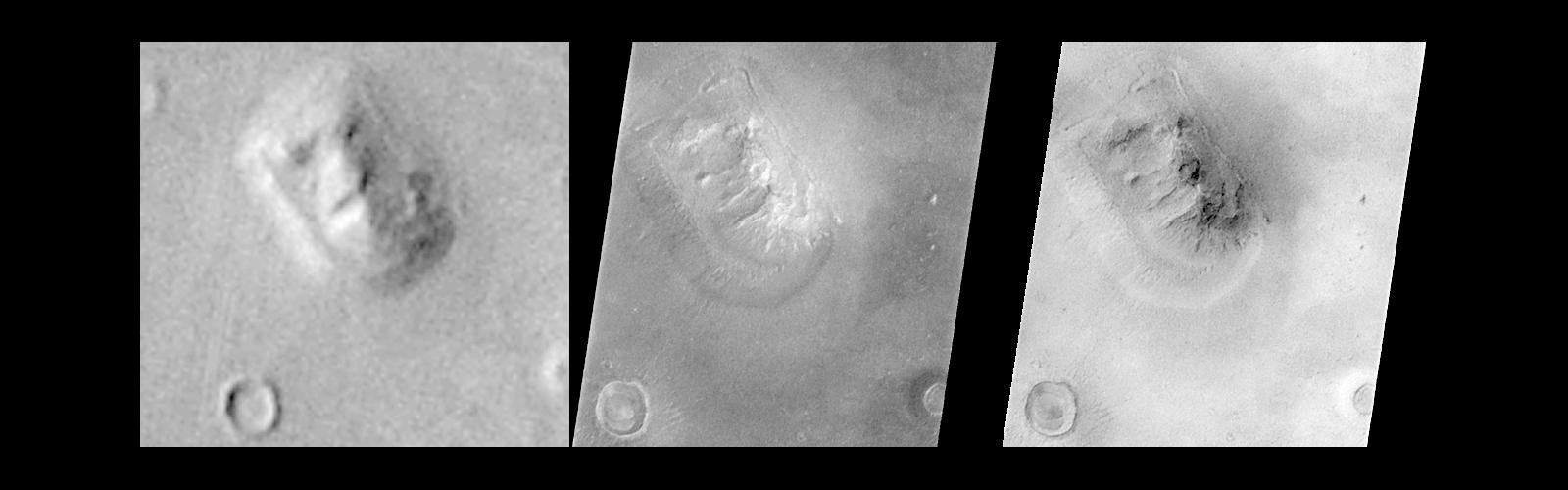 A side by side comparison released by NASA in 1998: the original Viking image on the left, the new Mars Orbiter Camera image in the center, and the same high resolution image adjusted to match Viking's lighting conditions on the right. Credit: NASA/JPL/Malin Space Science Systems.
NASA's own scientists were candid that the improved image confirmed exactly what the geology had always suggested. What changed in 1998 was public certainty. Scientific opinion inside the agency had been settled for years. For the first time, anyone could look at a photograph clear enough to see the formation's actual surface texture, an image far sharper than the coarse, error laden picture that 1970s technology had been able to deliver.
The explanation for the original illusion comes down to a combination of ordinary factors working together at exactly the right moment. Viking photographed Cydonia with the sun sitting low on the horizon, at an angle of about twenty degrees. Low sun angles create long shadows, and long shadows exaggerate the depth of any surface irregularity, turning a shallow ridge into what looks like a deep set eye socket or a sharply defined jawline.
Human vision adds its own layer to the effect. Our brains are extraordinarily good at detecting faces, a skill that almost certainly developed because recognizing another person's expression quickly was valuable for our ancestors' survival. Neuroscientists have traced this ability to a specific region of the brain, the fusiform face area, which activates strongly whenever the visual system encounters anything resembling two eyes and a mouth arranged in roughly the right proportions, even when the underlying object has nothing to do with a face at all. That same skill fires readily even when the input is ambiguous, a phenomenon researchers call pareidolia. It is the same mental process behind seeing animals in clouds or a face in the front grille of a car, and it applies just as easily to a shadowed hillside photographed from orbit.
Combine a naturally symmetrical mesa, a low sun angle exaggerating its shadows, a scattering of data transmission errors landing in almost exactly the right spots, and a visual system primed to find faces in ambiguous patterns, and the outcome is less mysterious than it first appears. None of these factors needed to be intentional or unusual on their own. They only needed to happen at the same time, in the same photograph, for the illusion to take hold.
One of the more persuasive details for anyone who takes a step back from the single famous photograph is what the rest of Cydonia looks like. The region is covered in dozens of hills, mesas, and knobs, many of which are similar in scale to the Face and formed by the exact same erosional processes.
 A broader infrared view of Cydonia from NASA's Mars Odyssey spacecraft, showing the Face as just one of dozens of similarly shaped knobs and mesas across the region. Credit: NASA/JPL/Arizona State University.
Seen at this wider scale, the Face stops looking like an isolated anomaly and starts looking like exactly what geologists always said it was: one weathered remnant among many, sitting at the boundary between Mars's older, cratered southern highlands and its smoother northern plains. This transition zone is littered with these leftover formations, all shaped by the same combination of wind erosion and the slow collapse of once continuous rock layers. The Face happened to erode into a shape people recognized. Its neighbors, just as old and shaped by identical forces, simply did not.
Planetary scientists have addressed the Face on Mars directly and repeatedly since the 1998 images became public, and their conclusions have not shifted since. The consensus is that the formation is a naturally occurring remnant mesa, geologically unremarkable except for the coincidence of its silhouette, and entirely consistent with the erosion patterns found throughout Cydonia and the broader dichotomy boundary region of Mars.
Later missions have added still more evidence without changing the underlying answer. The Mars Odyssey spacecraft imaged the formation again in infrared in 2002, and the Mars Reconnaissance Orbiter's HiRISE camera, capable of resolving objects less than a meter across, photographed Cydonia in even greater detail in the years that followed. Infrared surveys, additional high resolution imaging passes, and topographic mapping have all continued to describe the same feature: a mesa with sloped sides, flat resistant ledges partway up its face, and no structural evidence of construction, symmetry beyond what erosion naturally produces, or material composition distinct from the surrounding terrain. No serious planetary science publication in the years since has proposed an artificial origin, and no photographic evidence gathered by any mission has ever pointed toward one.
The Face is also far from the only landform on Mars that has caught the public eye this way. Orbital cameras have photographed a crater near the planet's south pole that briefly earned the nickname "Happy Face" for its uncanny resemblance to a smiling emoji, and in 2023 NASA's Mars Reconnaissance Orbiter captured a HiRISE image of a collapsed volcanic crater in the Arcadia Planitia region whose overlapping fractures and central pit read unmistakably as a bear's face, complete with two eye like craters and a rounded snout, a picture NASA itself shared as a lighthearted example of pareidolia instead of any kind of mystery. Mission teams have joked for years about spotting shapes resembling everything from a spoon to a screaming face among the countless rock formations photographed across the planet's surface. Mars, it turns out, is large enough and varied enough in its geology that pattern seeking human eyes are bound to find something familiar eventually, somewhere among millions of square kilometers of ancient terrain. The Face on Mars simply happened to be the first one photographed clearly enough, and publicized widely enough, to grow into a genuine cultural phenomenon instead of staying a passing curiosity noted in a mission log.
Given how thoroughly the scientific question has been settled, it is worth asking why the Face on Mars remains a subject people continue to search for and discuss. Part of the answer is simply that the original photograph is a genuinely striking image, one that does not stop looking like a face just because a clearer picture exists somewhere else. Most people who encounter the story see the 1976 photo first, often without the context of the later, sharper images, and a single arresting picture tends to stick in memory far more strongly than a technical explanation ever will.
There is also something deeper at work. A hidden monument on another world, built by an intelligence humanity never met, taps directly into one of the oldest questions people ask when they look up at the night sky: are we alone. That question does not go away just because one particular piece of evidence for a positive answer turned out to be a trick of light and shadow. The Face on Mars became a stand in for a much larger hope, and stand ins have a way of outliving the specific claims that first attached to them.
Cultural momentum matters too. Once a story becomes part of documentaries, books, and popular conversation, correcting it requires more effort than the original claim ever did. A striking photograph travels quickly. A careful geological explanation, however solid, travels more slowly, and rarely reaches the same audience with the same force.
The Face and the wider Cydonia region continue to show up in science fiction today, most recently as the setting for the central discovery in The Convergence Override by Sainath Mungara. Our survey of Cydonia's real geography covers the same region in more depth, and readers who enjoyed this piece may also want our companion look at the Black Knight satellite, another space photograph that outran its own explanation.
If the question is whether an artificial monument sits on the Martian surface at Cydonia, every piece of photographic and geological evidence gathered since 1976 points to no. The formation is a natural mesa, its resemblance to a face produced by ordinary erosion, a low sun angle, a handful of data transmission errors, and the very human tendency to see faces in ambiguous shapes. Higher resolution imaging in 1998, and every survey since, has shown the same weathered, geologically unremarkable hill sitting among dozens of similar formations across Cydonia.
If the question is whether something genuinely interesting happened, the answer is yes, just not the something most people expect. A routine landing site survey produced one of the most recognizable photographs in the history of space exploration almost by accident. That photograph, imperfect and compressed by the technological limits of its era, became a decades long case study in how a single striking coincidence can outrun its own explanation, traveling further and lasting longer than the sharper, quieter evidence that eventually settled the question for good.
The Face on Mars was never a message from another civilization. It turned out to be something almost as interesting in its own right: a demonstration of exactly how easily an ordinary rock, under the right light, can convince an entire planet that it is looking at something else. Every subsequent mission to photograph Cydonia, from Mars Odyssey's infrared surveys to the Mars Reconnaissance Orbiter's HiRISE passes, has only reinforced that conclusion, adding sharper and more detailed evidence to a question planetary scientists settled decades ago.
Is the Face on Mars real? The formation itself is real and sits in the Cydonia region of Mars, but it is a natural mesa, not an artificial structure. Higher resolution imaging taken in 1998 and afterward confirmed it as an ordinary, weathered landform.
What caused the Face on Mars to look like a face? A combination of a low sun angle creating exaggerated shadows, natural erosion producing a roughly symmetrical shape, several data transmission errors landing across key features of the image, and the human brain's strong tendency to recognize faces in ambiguous patterns.
When was the Face on Mars photographed? It was first photographed by NASA's Viking 1 orbiter on July 25, 1976. A much higher resolution image was taken by the Mars Global Surveyor spacecraft on April 5, 1998, which showed the formation clearly as a natural hill.
Where is the Face on Mars located? In the Cydonia region of Mars, near the boundary between the planet's cratered southern highlands and its smoother northern plains, at approximately 40.8 degrees north latitude.
Does the Face on Mars appear in any books? It appears as the real world backdrop for the central discovery in the science fiction novel The Convergence Override by Sainath Mungara, which uses Cydonia's actual coordinates and terrain across several of its Martian chapters.