Mission Archive / Signal Log
Ganymede: Jupiter's Moon That's Larger Than Mercury, and a Real Candidate for Human Colonization
Mars gets almost all of the attention when people talk about where humanity might live next. It is closer, it is familiar from decades of rover footage, and it has a thin but real atmosphere that at least resembles something you could work with. But roughly 365 million miles farther out, orbiting the largest planet in the solar system, sits a moon that quietly outperforms Mars on several of the measures that matter most for long term survival: water, energy potential, and even a magnetic field of its own.
That moon is Ganymede, Jupiter's largest satellite and the largest moon in the entire solar system, a body so big that it is larger than the planet Mercury. This article works through the real science behind Ganymede as a colonization target, compares it honestly against Mars, and answers the practical questions anyone weighing the two destinations would actually ask: how far away it is, how long it would take to get there with today's engines and with the nuclear propulsion systems currently in development, what a colonist's first days would look like, and what the sky itself would look like from the surface.
Ganymede orbits Jupiter at a distance of about 665,000 miles (1.07 million kilometers), completing one full orbit every 7.15 Earth days. It measures roughly 3,270 miles (5,268 kilometers) across, which makes it larger than Mercury, larger than Pluto, and more than twice as massive as Earth's own Moon. Despite its size, Ganymede is only about 45 percent as massive as Mercury, a result of its composition: roughly equal parts rock and water ice, instead of the dense metal and silicate mix that makes up the terrestrial planets.
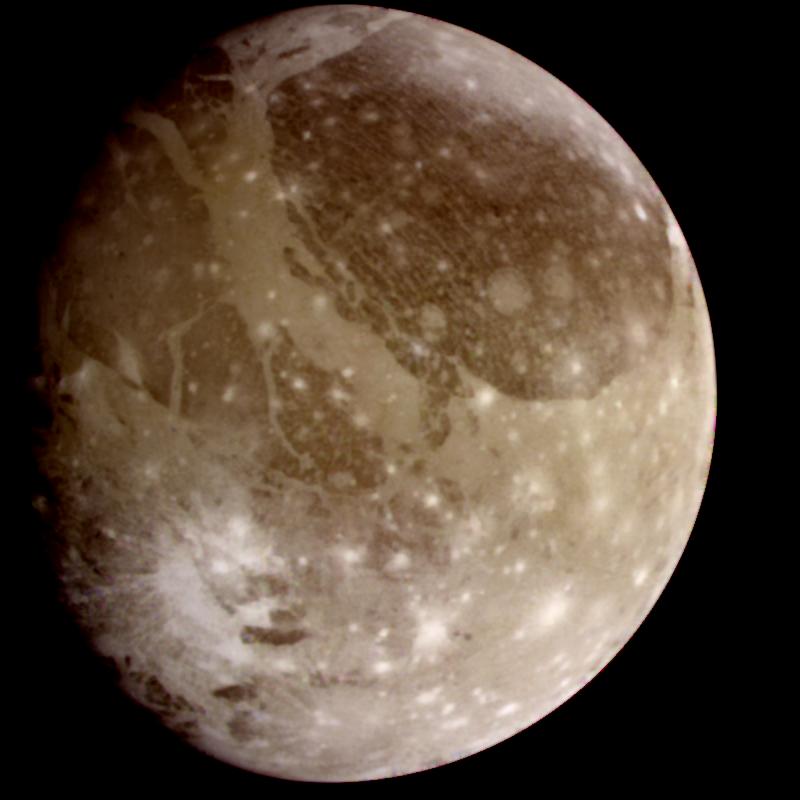 Ganymede's surface shows two distinct kinds of terrain: dark, ancient, heavily cratered regions and lighter, younger terrain crossed by long tectonic grooves. Credit: NASA/JPL.
Ganymede formed alongside Jupiter roughly 4.5 billion years ago and is fully differentiated, meaning it has settled into distinct internal layers over time instead of remaining a uniform mixture. At its center sits a metallic iron core, surrounded by a rocky mantle, topped by a thick shell of ice that includes, several dozen miles down, a layer of liquid saltwater. That internal structure took shape unusually fast by planetary standards: models of Ganymede's formation suggest the accretion process that built the moon took only about 10,000 years, fast enough that leftover heat from the process likely helped melt the ice and separate it from the rock, settling the heavier material into the core we see today. That ocean is the single most important fact about Ganymede for anyone thinking about colonization, and it deserves its own section further down.
Ganymede also holds a distinction shared by no other moon in the solar system: it generates its own internal magnetic field, a feature otherwise limited to planets. That field creates a small magnetosphere of its own, nested inside Jupiter's much larger one, and it produces auroras around Ganymede's poles in much the same way Earth's magnetic field produces the northern and southern lights.
Jupiter orbits the Sun at an average distance of about 484 million miles (778 million kilometers), or 5.2 astronomical units, meaning it sits roughly five times farther from the Sun than Earth does. Because both planets are moving along their own orbits, the straight line distance between Earth and Jupiter changes constantly, ranging from around 365 million miles at its closest to more than 600 million miles when the two planets sit on opposite sides of the Sun. Spacecraft do not travel in a straight line anyway. They follow curved transfer orbits shaped by the gravity of the Sun and, often, by deliberate flybys of other planets used to pick up extra speed for free.
Real missions give the clearest picture of what current chemical propulsion can achieve. NASA's Galileo probe took about six years to reach Jupiter, arriving in 1995 after a roundabout path that used gravity assist flybys of Venus and Earth to build up enough speed. Juno, launched in 2011, took five years, using a single Earth flyby along the way. The European Space Agency's JUICE mission, launched in April 2023, is on a longer roughly eight year path that uses multiple gravity assist flybys of Earth and Venus to save fuel, with arrival at Jupiter expected around 2031 and orbit insertion around Ganymede itself planned for 2032, making JUICE the first spacecraft ever to orbit a moon other than our own. NASA's Europa Clipper, launched in October 2024, takes a comparatively brisk five and a half years using a single Mars gravity assist, with its first close flybys of Ganymede expected to begin around 2030. New Horizons flew past Jupiter in just over a year in early 2007, but that was a high speed flyby on its way to Pluto, not a mission designed to slow down and enter orbit, which takes vastly more propellant and time than simply passing through the system at speed.
For a crewed Ganymede mission using engines similar to what exists today, a realistic transit window sits somewhere between two and six years one way, heavily dependent on trajectory choices, how much fuel a mission is willing to spend cutting travel time, how many gravity assist flybys the mission plan allows for, and how much cargo and crew life support the spacecraft needs to carry alongside its human occupants.
This is where the picture changes substantially. Chemical rockets get their thrust from burning propellant in a combustion chamber, a process that fundamentally limits how much velocity a given amount of fuel can provide. Nuclear propulsion swaps that combustion for a fission reactor, either heating propellant directly and blasting it out a nozzle, known as nuclear thermal propulsion, or generating electricity to power a separate high efficiency thruster, known as nuclear electric propulsion.
NASA and DARPA's DRACO program, developed jointly with Lockheed Martin and BWX Technologies before funding challenges paused it, aimed to demonstrate nuclear thermal propulsion that NASA projected could cut travel time to Mars roughly in half compared with chemical engines, moving a Mars trip from about seven to nine months down toward three to four months. Applied to the much greater distance involved in reaching Jupiter, published mission design studies suggest a nuclear thermal spacecraft could make a direct transfer to Jupiter in about 2.1 years, compared with five to six years for a typical chemical mission covering similar cargo.
Nuclear electric propulsion offers a different tradeoff. Rather than a single powerful burn, it provides continuous, gentle acceleration over the entire trip, using far less propellant for the same eventual speed. Engineering studies modeling nuclear electric transfers to Jupiter have found potential travel times of around 660 days, close to a year and ten months, while also increasing the mass of cargo or crew supplies the spacecraft could carry compared with an equivalent chemical mission.
Put simply: today's chemical rockets can get a crewed mission to Ganymede in roughly five to six years. A functioning nuclear thermal rocket could plausibly cut that to around two years. A mature nuclear electric system could arrive in a similar window while hauling significantly more supplies, at the cost of a more complex, higher power spacecraft. None of these nuclear systems have flown a crewed interplanetary mission yet, but the underlying reactor technology is real, tested on the ground, and actively funded as of the mid 2020s.
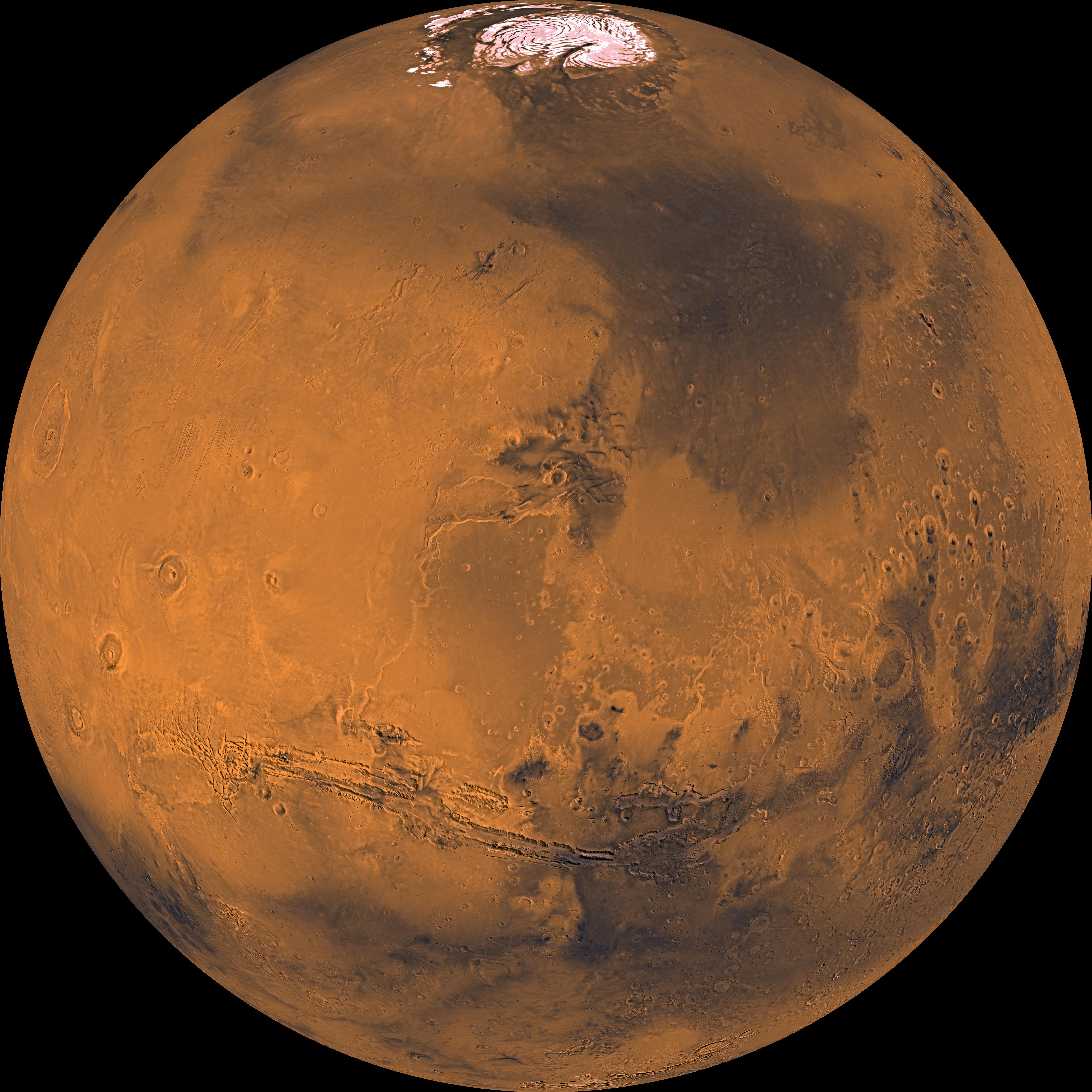 Mars remains the nearer, faster, and in several ways easier destination. Ganymede trades that convenience for water, energy potential, and a magnetic field Mars simply does not have. Credit: NASA/JPL/USGS.
Mars wins on distance and travel time by a wide margin, reachable in seven to nine months using existing engines compared with years for Ganymede. Mars also offers a real, if thin, atmosphere, providing about one hundred and sixtieth of Earth's surface pressure, enough to support some weather, dust storms, and a modest buffer against micrometeorites and radiation that Ganymede's essentially airless surface cannot match. Mars gravity, at about 38 percent of Earth's, is also considerably friendlier to the human body over long stretches than Ganymede's mere 14.6 percent.
Where Ganymede pulls ahead is resources and shielding potential. Its water ice crust holds more water than every ocean on Earth combined, an almost unimaginable reserve for life support, fuel production, and radiation shielding. Its own magnetic field, however partial, is something Mars entirely lacks, since Mars lost its global magnetic field billions of years ago. And because so much of a Ganymede colony would necessarily sit underground or under thick ice for protection anyway, its lack of surface atmosphere matters less than it would somewhere colonists might otherwise walk outside unprotected.
Distance remains Ganymede's central disadvantage. Every supply run, every emergency evacuation, every piece of replacement equipment takes years to arrive instead of months, and every radio message takes between 33 and 53 minutes to cross the gap one way, depending on where Earth and Jupiter currently sit in their orbits. A Ganymede colony would need to be far more self sufficient than any Mars settlement, simply because asking Earth for help is not a fast option.
Ganymede's surface gravity comes out to about 1.43 meters per second squared, roughly 14.6 percent of Earth's. That is noticeably weaker than Mars and only slightly stronger than Earth's own Moon. Long term human health effects of gravity this low remain an open scientific question, since no human has ever lived for extended periods anywhere with gravity this weak, though the general expectation from research on microgravity and lunar gravity analogs is meaningful bone density loss, muscle atrophy, and cardiovascular deconditioning without a dedicated countermeasure program of resistance exercise and possibly artificial gravity during transit.
Ganymede's atmosphere, meanwhile, barely qualifies as one at all. Surface pressure sits somewhere around a millionth of Earth's atmospheric pressure, made up mostly of trace oxygen along with smaller amounts of ozone and atomic hydrogen, produced when charged particles and ultraviolet light break apart water ice at the surface. Researchers describe this properly as an exosphere instead of a true atmosphere, since the molecules are so sparse that they rarely collide with each other at all, behaving more like individual particles on independent ballistic paths than a connected gas. A human standing unprotected on Ganymede's surface would face conditions functionally identical to open vacuum: no breathable air, no meaningful pressure to keep body fluids from boiling, and no protection whatsoever from radiation or temperature extremes. Every single moment spent outside a pressurized structure or suit would require full spacesuit protection, precisely as it would on the Moon or in open space.
If Ganymede has one overwhelming argument in its favor, it is water. Evidence gathered by the Galileo spacecraft in the 1990s, and confirmed more recently through Hubble Space Telescope observations of Ganymede's auroras, points to a global subsurface ocean of salty water sitting roughly 95 miles (150 kilometers) beneath the icy surface, itself estimated to be about 60 miles (100 kilometers) thick, ten times the depth of any ocean on Earth. Combined, scientists estimate Ganymede holds more water than every ocean on Earth's surface put together.
For a colony, that water is not just a curiosity. It is drinking water, agricultural water, and shielding mass, all in one, and it is also rocket fuel waiting to be extracted. Water molecules split by electrolysis yield hydrogen and oxygen, the same propellant combination used by many of the most efficient chemical rockets ever built, along with breathable oxygen for habitat life support. A colony positioned to access even the near surface ice, without needing to drill anywhere close to the deep ocean itself, would have effectively limitless raw material for both survival and refueling outbound spacecraft, a resource advantage no Mars settlement can match at anywhere near the same scale.
Ganymede is the only moon in the solar system known to generate its own magnetic field, produced by a dynamo effect inside its liquid iron rich core, first detected by the Galileo spacecraft in 1996. That field is real, and it does create a genuine, if small, magnetosphere around the moon.
It is worth being precise about what that shield actually does, though. Ganymede's field sits embedded entirely within Jupiter's own vastly larger magnetosphere, and Jupiter's field dominates the local space environment. As a result, Ganymede's own magnetic field does not meaningfully protect the surface from Jupiter's intense radiation belts the way Earth's magnetic field protects us from the solar wind. Surface radiation on Ganymede still measures around 5 to 8 rem per day, an amount that would cause serious radiation sickness after roughly two months of continuous, unshielded exposure.
The comparison to Ganymede's neighboring moons puts that number in useful context. Europa, closer to Jupiter, receives about 540 rem per day, enough to be fatal within a single day of exposure. Io, closer still, receives an extraordinary 3,600 rem per day. Callisto, the outermost of the four large Galilean moons, sits far enough from Jupiter's main radiation belts to receive only about 0.01 rem per day, which is why some mission planning studies have identified Callisto instead of Ganymede as the safest surface for a long term crewed base in the Jupiter system. Ganymede represents a middle ground: meaningfully safer than Europa or Io, but still requiring serious shielding, unlike Callisto, which sits farther out and, in most study scenarios, offers less water and weaker scientific interest.
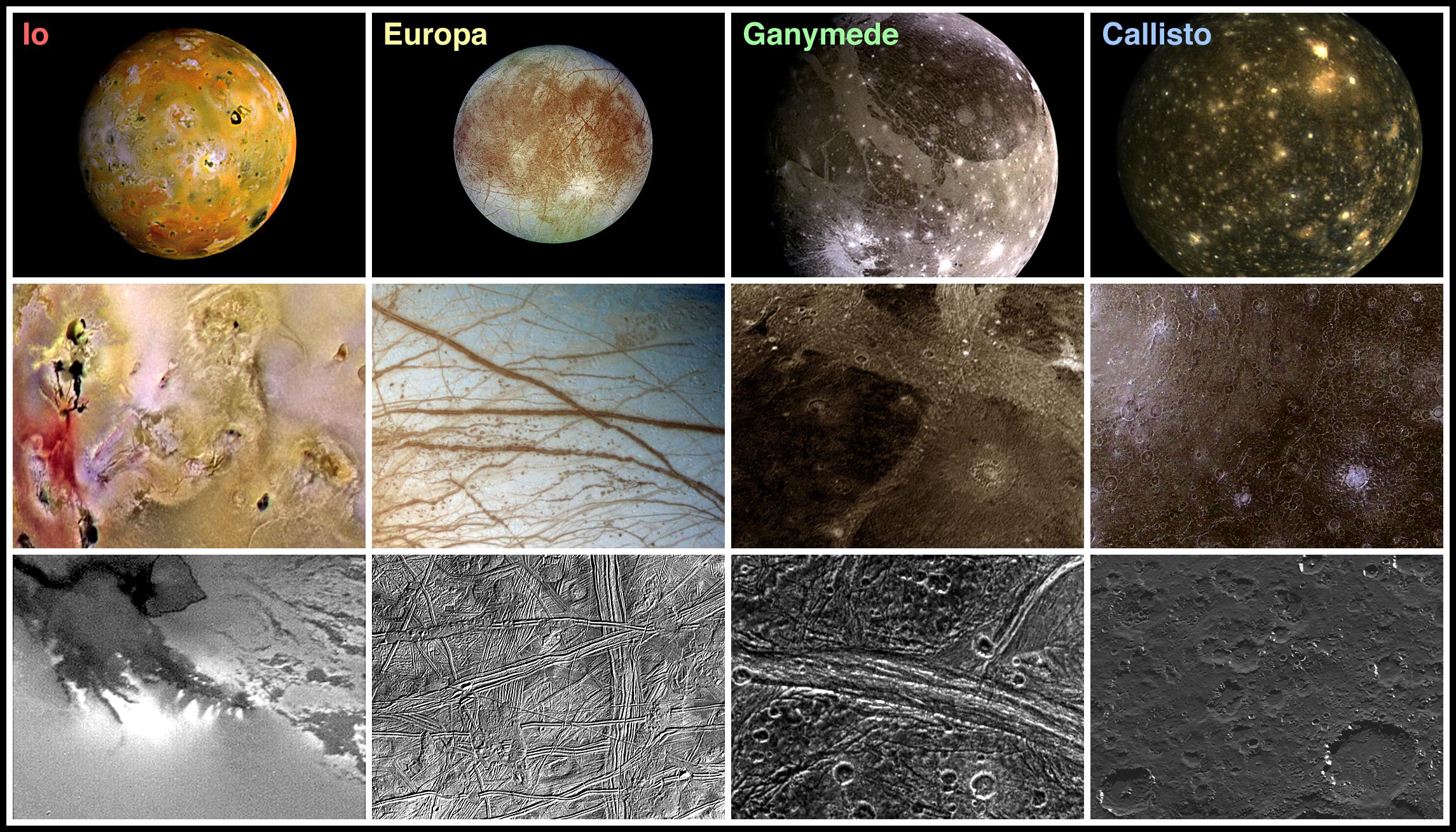 From left to right: Io, Europa, Ganymede, and Callisto, photographed by NASA's Galileo spacecraft. Radiation exposure drops sharply with distance from Jupiter, from thousands of rem per day at Io to a small fraction of a rem at Callisto. Credit: NASA/JPL/DLR.
Anyone landing on Ganymede for the first time would face a stacked set of problems that all demand solutions before a single person can safely step outside a spacecraft.
Radiation tops the list. At 5 to 8 rem per day at the surface, unshielded exposure would produce dangerous cumulative doses within weeks, meaning every habitat needs either several meters of ice or regolith shielding, or a location built directly into the subsurface where Ganymede's own mass provides natural protection.
Cold comes next. Daytime surface temperatures range from about minus 113 to minus 183 degrees Celsius (minus 171 to minus 297 Fahrenheit), colder throughout than almost anywhere on Earth, including Antarctica's worst recorded readings. Any exposed equipment, seals, or materials need to be engineered for these temperatures without becoming brittle or failing.
The near vacuum surface pressure means every habitat needs full pressurization, effectively building something closer to a spacecraft that happens to sit on solid ground than a building in any conventional Earth sense, with all the redundancy and leak detection systems that implies.
Sunlight is a further complication that often gets overlooked. At Jupiter's distance from the Sun, sunlight arrives at only about 3.7 percent of the intensity it has at Earth, a consequence of the inverse square law acting across 5.2 astronomical units. Solar panels that work well on Mars or the Moon become far less practical at Ganymede, producing only a small fraction of the power per square meter that they would closer to the Sun. This effectively rules out solar power as a primary energy source and points directly toward nuclear fission reactors as the only realistic option for running life support, heating, manufacturing, and everything else a colony needs continuously.
Communication delay adds a psychological and operational burden on top of the physical ones. Depending on the current positions of Earth and Jupiter, a radio signal takes between roughly 33 and 53 minutes to make the one way trip, meaning any real time conversation with Earth is impossible and every request for guidance during an emergency arrives at best an hour late in round trip terms. Colonists would need training and authority to make consequential decisions entirely on their own.
None of the problems above are unsolvable, and in most cases the solutions already exist in some form, tested on Earth, on the International Space Station, or in NASA's current technology development programs.
Radiation shielding is mostly a matter of mass. A few meters of packed ice or regolith placed between a habitat and open sky reduces radiation dose dramatically, and Ganymede conveniently sits on top of more ice than a colony could ever need for this purpose. Building primary living quarters underground, or under a deliberately piled berm of surface ice, solves most of the radiation problem using material already on site instead of anything shipped from Earth at enormous cost. Studies of lunar and Martian habitat shielding suggest that roughly two to three meters of packed regolith or ice can cut incoming radiation dose by a factor of ten or more, and Ganymede's ice is, if anything, an even better shielding material than the drier regolith found on the Moon or Mars, since the hydrogen atoms in water ice are particularly effective at absorbing high energy particles.
Power generation points toward nuclear fission surface systems, a technology NASA has already been actively developing and testing for Moon and Mars bases under its fission surface power program. A compact reactor providing continuous kilowatt scale electricity regardless of sunlight, weather, or time of day is a natural fit for Ganymede's dim, week long day and night cycle, and the same reactor technology under development for lunar and Martian outposts would transfer directly to a Ganymede setting with appropriate radiation hardening for the local environment.
Water and fuel production follows directly from Ganymede's ice. Melting surface ice and running the resulting water through electrolysis yields breathable oxygen for the habitat's life support loop and hydrogen and oxygen propellant for return vehicles or resupply craft, turning Ganymede from a destination that needs everything shipped in in advance into one that can refuel and resupply substantial parts of its own operation locally.
Cold and vacuum are, in an important sense, the most solved problems on this list, since spacecraft, spacesuits, and the International Space Station already operate successfully in conditions of comparable or greater temperature extremes and identical vacuum exposure. The engineering challenge on Ganymede is one of scale and duration instead of a fundamentally new problem.
A less obvious challenge worth naming directly is the psychological weight of the environment itself. A seven day light and dark cycle, sunlight dim enough to feel like permanent overcast weather, a communication lag that rules out any real time conversation with Earth, and years between the possibility of returning home all place real strain on crew wellbeing that no amount of engineering alone resolves. NASA's own research into long duration spaceflight, drawn from year long ISS stays and simulated Mars mission analogs, points toward careful crew selection, structured schedules, deliberate lighting design that mimics a healthy day and night rhythm regardless of what the sky outside is doing, and strong communication protocols as being just as essential to a successful Ganymede mission as any radiation shield or power reactor.
Yes, and comfortably, provided the habitat does its job. Inside a structure that maintains Earth like internal air pressure, an Earth like oxygen and nitrogen mixture, and Earth like internal temperature, with adequate radiation shielding from the surrounding ice or regolith, there is no fundamental reason a human being could not live in good health indefinitely, aside from the open question of how the body adapts over years to Ganymede's low gravity.
What would never become casual, unlike a well established Mars base in some optimistic future scenarios, is stepping outside without a full pressure suit. Mars offers at least the prospect of surface activity in a lighter protective suit given its partial atmosphere and comparatively survivable temperature range. Ganymede offers no equivalent middle ground. Every excursion beyond the shielded habitat perimeter means a complete spacesuit, exactly as it would on the Moon, for the entirety of a colony's existence.
Terraforming, in the sense of engineering an entire moon or planet to support an Earth like atmosphere and climate that people could walk around in unprotected, runs into several hard physical limits at Ganymede that make it far less plausible than it might be for Mars, itself already an extremely long shot.
Ganymede's gravity, at under 15 percent of Earth's, is too weak to hold onto a thick atmosphere over geological time even under the most generous assumptions, since lighter gas molecules gradually escape into space at low gravity far faster than they would on a more massive world. Ganymede's distance from the Sun, at over five times Earth's distance, means any atmosphere thick enough to trap heat would still leave the surface extremely cold without an enormous, continuous artificial heat source working alongside it. And Ganymede's position deep inside Jupiter's radiation environment means any newly built atmosphere would face constant bombardment from charged particles, gradually stripping it away in a process the moon's own partial magnetic field is not strong enough to fully prevent.
A far more realistic model for Ganymede, and one already well established in space architecture thinking, is paraterraforming: building sealed, pressurized, heated domes or underground complexes that recreate Earth like conditions within a contained structure instead of across an entire world. This is essentially an expanded version of the habitat approach already necessary for basic survival there, scaled up over decades into larger connected complexes, gardens, and living spaces, all still fundamentally sealed environments instead of an open, breathable moon.
Some longer range engineering proposals go further still, imagining vast transparent domes kilometers wide covering entire valleys or crater floors, pressurized with a thick, breathable air mixture and warmed by nuclear or, eventually, fusion power, effectively building an artificial biosphere under glass instead of attempting to change the moon itself. Even in the most optimistic version of this idea, Ganymede's own open sky, its actual surface conditions, and its native vacuum would remain permanently unchanged outside whatever structures colonists build. The moon is not becoming a second Earth in any scenario grounded in real physics. At best, it becomes host to a growing collection of engineered, self contained worlds sitting on top of it.
Sitting inside Jupiter's magnetosphere shapes almost everything about life on Ganymede, for better and worse. On the challenging side, Jupiter's intense radiation belts are the direct source of Ganymede's elevated surface radiation, and Jupiter's overwhelming gravity is the reason Ganymede, like the Moon around Earth, has become tidally locked, always showing the same face to its parent planet.
On the more interesting side, that same proximity means Jupiter dominates Ganymede's sky in a way nothing dominates Earth's, a detail worth its own dedicated look, since it shapes what daily life would actually feel like for anyone living there.
This is one of the more genuinely strange aspects of living on Ganymede, and it comes from two separate effects stacking on top of each other: Ganymede's slow rotation and its extreme distance from the Sun.
Because Ganymede is tidally locked to Jupiter, one hemisphere always faces the planet while the other never sees it at all. But Ganymede still rotates relative to the Sun once every orbit, completing that rotation in the same 7.15 Earth days it takes to circle Jupiter. That means a full day and night cycle relative to the Sun, one sunrise to the next, takes about seven Earth days, with roughly three and a half days of sunlight followed by roughly three and a half days of darkness. Sunrise and sunset themselves would stretch out far more slowly than on Earth, since Ganymede's much slower spin means the Sun's small disk creeps across the sky and through the horizon far more gradually than the brisk hour or so Earth allows for a sunset.
The Sun itself would look noticeably different too. At 5.2 astronomical units from the Sun, Ganymede receives only about 3.7 percent of the sunlight intensity Earth gets, and the Sun's disk itself would appear roughly a fifth the width it does from Earth, small enough to clearly read as a disk instead of a point, but nowhere near the bright presence it is in Earth's sky. Daylight on Ganymede would resemble a persistently dim, heavily overcast afternoon instead of a bright sunny day, even at local noon with a clear sky.
For anyone living on Ganymede's Jupiter facing hemisphere, the far more dramatic sight would be Jupiter itself, which would hang in a fixed point in the sky, never rising or setting, exactly as Earth hangs fixed in the sky for one side of our own Moon. Jupiter's apparent size from Ganymede works out to roughly fourteen times the width of the full Moon as seen from Earth, an enormous, banded, constantly shifting presence dominating a huge portion of the sky. Because the angle between Ganymede, Jupiter, and the Sun changes across each seven day orbit, Jupiter would visibly move through phases, similar to how our Moon shows crescent, half, and full phases from Earth, alternating between a thin crescent and a fully lit disk over the course of every orbit. During Ganymede's nighttime hours, sunlight reflecting off Jupiter's clouds would cast a soft secondary illumination across the near side hemisphere, a far more intense version of the faint earthshine visible on our own Moon during its crescent phases.
Colonists on Ganymede's far hemisphere, the side permanently turned away from Jupiter, would never see any of this. For them, Jupiter simply would not exist in the sky at all, a genuinely strange trade off that any site selection process for a real colony would need to weigh carefully, balancing the practical and psychological value of a Jupiter view against other engineering considerations for where to build.
Mars will almost certainly remain humanity's first stop beyond the Moon, and there is no serious argument that Ganymede should be attempted before Mars. Our own survey of Martian geography and the Borderleap Initiative both cover that first stop in more depth. But framed as a second or third destination, once nuclear propulsion and fission power systems mature past their current development stage, Ganymede offers something genuinely rare: a body large enough to be mistaken for a small planet, sitting on more water than every ocean on Earth combined, generating its own magnetic field, and positioned at the gateway to the rest of the outer solar system.
Getting there will take years instead of months, even with the best propulsion currently in serious development. Living there will mean permanent underground or ice shielded habitats, full spacesuits for every step outside, and nuclear reactors instead of solar panels running everything from lighting to life support. None of that is science fiction. It is closer to a detailed engineering to do list, built from missions already flown and technology already being tested, for a moon that just happens to be larger than the planet Mercury, and that may end up being worth every year the trip there takes.
Ganymede also has a newer connection to fiction: it is where the story of The Convergence Override by Sainath Mungara is expected to move in Book Two, currently in production, following on from the novel's Mars based opening. Readers who enjoyed this piece may also want our companion articles on the Face on Mars and the Black Knight satellite.
How far is Ganymede from Earth? The straight line distance changes constantly as both planets orbit the Sun, ranging from around 365 million miles at closest approach to more than 600 million miles at the farthest. Jupiter itself sits about 484 million miles (778 million kilometers) from the Sun on average, roughly 5.2 astronomical units, or five times Earth's own distance from the Sun.
How long would it take to reach Ganymede with current technology? Real missions using chemical propulsion and gravity assist flybys have taken between five and eight years, based on the flight times of Galileo, Juno, JUICE, and Europa Clipper. A dedicated crewed mission optimized purely for speed instead of fuel efficiency could plausibly shorten that to somewhere near two to four years.
How much faster would nuclear propulsion make the trip? Published mission design studies suggest nuclear thermal propulsion could achieve a direct transfer to Jupiter in about 2.1 years, while nuclear electric propulsion studies point to travel times near 660 days, close to a year and ten months, while also carrying more cargo than an equivalent chemical mission.
Does Ganymede have breathable air? No. Its surface pressure is roughly a millionth of Earth's, made up of trace oxygen, ozone, and hydrogen too sparse to breathe or to protect against vacuum exposure. Every moment spent outside a pressurized habitat or suit requires full spacesuit protection.
Is there water on Ganymede? Yes, in enormous quantities. A subsurface saltwater ocean roughly 60 miles thick, buried beneath about 95 miles of ice, is estimated to hold more water than every ocean on Earth combined, making Ganymede one of the best resupply and refueling locations anywhere in the outer solar system.
Could Ganymede be terraformed? Not realistically, given current or foreseeable technology. Its weak gravity, extreme distance from the Sun, and exposure to Jupiter's radiation environment make holding a thick, breathable atmosphere over any meaningful timescale implausible. Sealed, pressurized habitats and domes, instead of an open breathable moon, represent the realistic path forward.
What does the sky look like from Ganymede? On the hemisphere that faces Jupiter, the planet hangs permanently fixed in the sky, appearing roughly fourteen times wider than Earth's full Moon and cycling through visible phases over each seven day orbit. The Sun appears small and dim, delivering under four percent of the sunlight Earth receives, and a full day and night cycle lasts about seven Earth days.